
What a Lompoc Resident Search Can Establish
The phrase resident lookup covers several record paths. The Santa Barbara County Assessor can tie a known parcel to a situs, transfer, improvement, and recorder document number, but its public web card does not display the owner name or mailing address. The recorder can identify indexed parties to an instrument. The court can expose public register events. The state can show a license, business filing, unclaimed-property lead, or the authenticated voter's own registration status.
Use the coverage table before opening a search box. It keeps a result tied to the office, access rule, and meaning that the source can support.
| Record | What it confirms | Where | Access and limit |
|---|---|---|---|
| Assessor parcel | Property and address relationship, transfer, APN | Santa Barbara County Assessor | Free parcel search; owner is not displayed online |
| Recorded document | Indexed party, instrument, date, legal description | County Clerk-Recorder | Live index states 1900-current; copy order is separate |
| Court register | Case number, type, parties, events, disposition where public | Santa Barbara Superior Court | Sealed, confidential, juvenile, and protected material excluded |
| Voter status | Own registration, polling, ballot, and county-contact details | California Secretary of State | Identity-authenticated self-lookup |
| Vital record | Birth, death, marriage, or dissolution event | County, CDPH, or Superior Court | Authorized and informational copy rules apply |
| Directory or yearbook | Historical household, school, address, or local mention | Library, SBCGS, LVHS, or archive | Secondary clue; confirm with an independent source |
A strong Lompoc resident lookup records the source's date and role. It does not turn a business agent into a household member or a historical directory entry into a current address.
Note: A record's keeper and access rule are part of the result, not background details to discard after a name appears.
Build a Two-Anchor Lompoc Identity Match
Same-name errors are common when a name crosses deeds, court cases, business filings, licenses, and OCR newspapers. Start with the person's full name as known, then add a date window and one context clue. The recorder supports sound-alike, fuzzy, starts-with, required, excluded, and phrase searching. The SBCGS local-name database recommends alternate spellings, nicknames, event locations, and role keywords.
Two independent anchors should agree before a result is treated as a useful match. A middle initial plus a spouse, an APN plus a legal description, a case number plus party role, or a business filing plus a date can separate people who share a surname. A name and a similar age alone are not enough.
- Write the exact name and every known spelling, including former or married forms.
- Set a date window from the event, address, directory year, or court filing.
- Run the record-specific search and save the result number, page, or document reference.
- Test the leading match against a second source with a different keeper.
- Label the result as confirmed, plausible, or unresolved; do not fill the gap with guesswork.
When the starting clue is an address rather than a name, use the Lompoc by-street records chain first. It is often easier to anchor an APN and transfer than to search a common surname without place context.
Lompoc Court Search and the Local Terminal
The Superior Court Case Information portals cover public categories such as civil, criminal, family, probate, small claims, and traffic registers, subject to confidentiality and sealing rules. The Civil Portal offers allowable civil register entries and non-confidential images. Family and Probate remain in the Public Portal. The local online criminal index is not available.
That absence changes the workflow. Use the Lompoc Courthouse public terminal or a written copy request for allowable criminal information. The courthouse is at 115 Civic Center Plaza, Lompoc, California 93436-6967. Building hours are listed as Monday through Friday, 8:00 a.m. to 3:00 p.m.; civil and family use 805-737-5452, and criminal uses 805-737-7789. The court does not confirm a party's DOB, address, last four SSN, or driver-license number by phone or email.
The court search image below is linked to the official case-information page. Open the Santa Barbara case search to choose the correct public category.
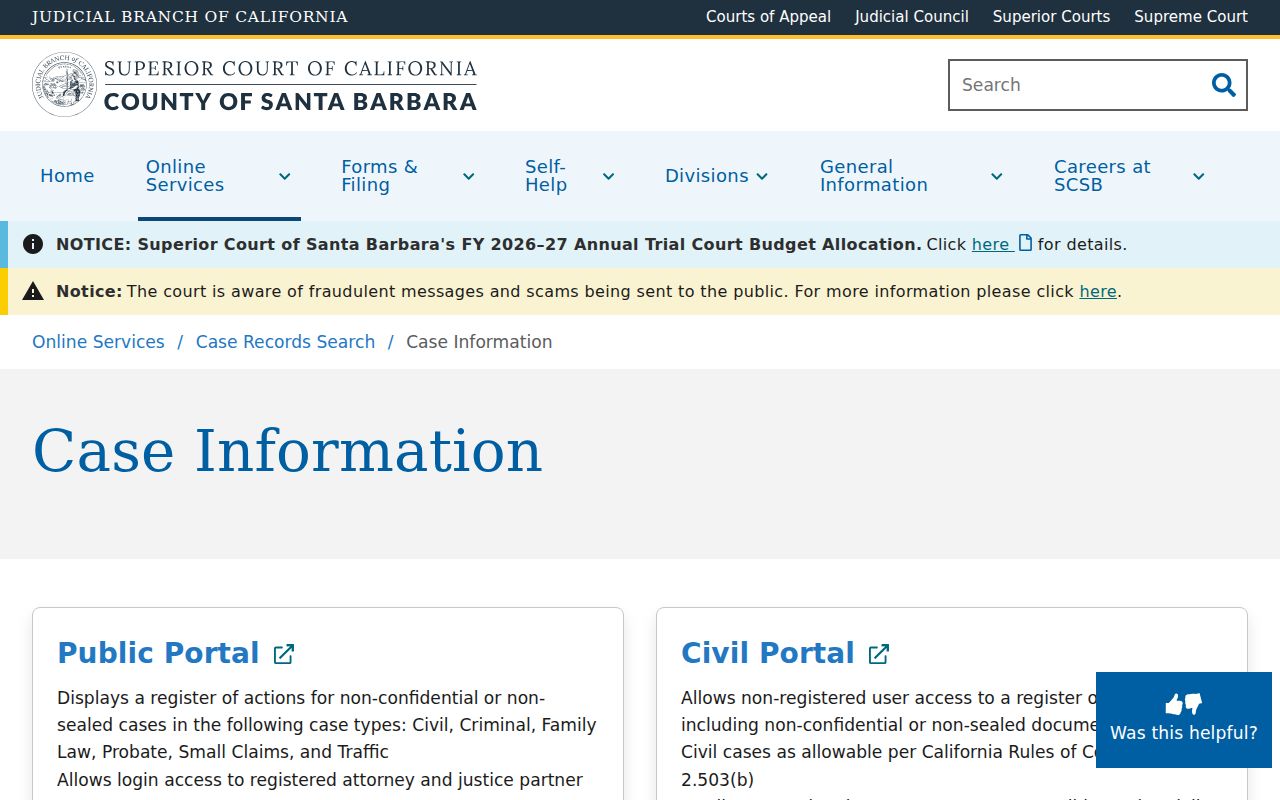
A public register can include case number, type, parties, filing or register events, and hearing or disposition information where public. Certification is listed at $25, and a search taking more than ten minutes is listed at $15. Small claims for the Lompoc venue is handled at Cook Division in Santa Maria, not the Lompoc counter, since September 1, 2013.
Note: The Lompoc courthouse terminal fills the local criminal-index gap, but court staff still protect confidential identity details.
Lompoc Voter Status Is an Authenticated Check
My Voter Status is a self-lookup. The form asks for first name, last name, date of birth, and, when available, a California driver-license or state-ID number or the last four digits of an SSN. The return can show registration status and location, party and language preference, mail or provisional-ballot status, polling place, upcoming election information, and county contact details.
The voter-file route is different. A qualified requester must state an election, scholarly, journalistic, political, or governmental purpose, identify the requester, select the product and scope, provide ID, and accept security and use conditions. California Elections Code sections 2188 through 2194 restrict the file. Driver-license and state-ID numbers, SSN fragments, unique identifiers, and signatures are excluded. Elections Code section 18109 penalizes unauthorized use.
The authenticated form image below is linked to the state service. Check California voter status only for the voter completing the identity check.
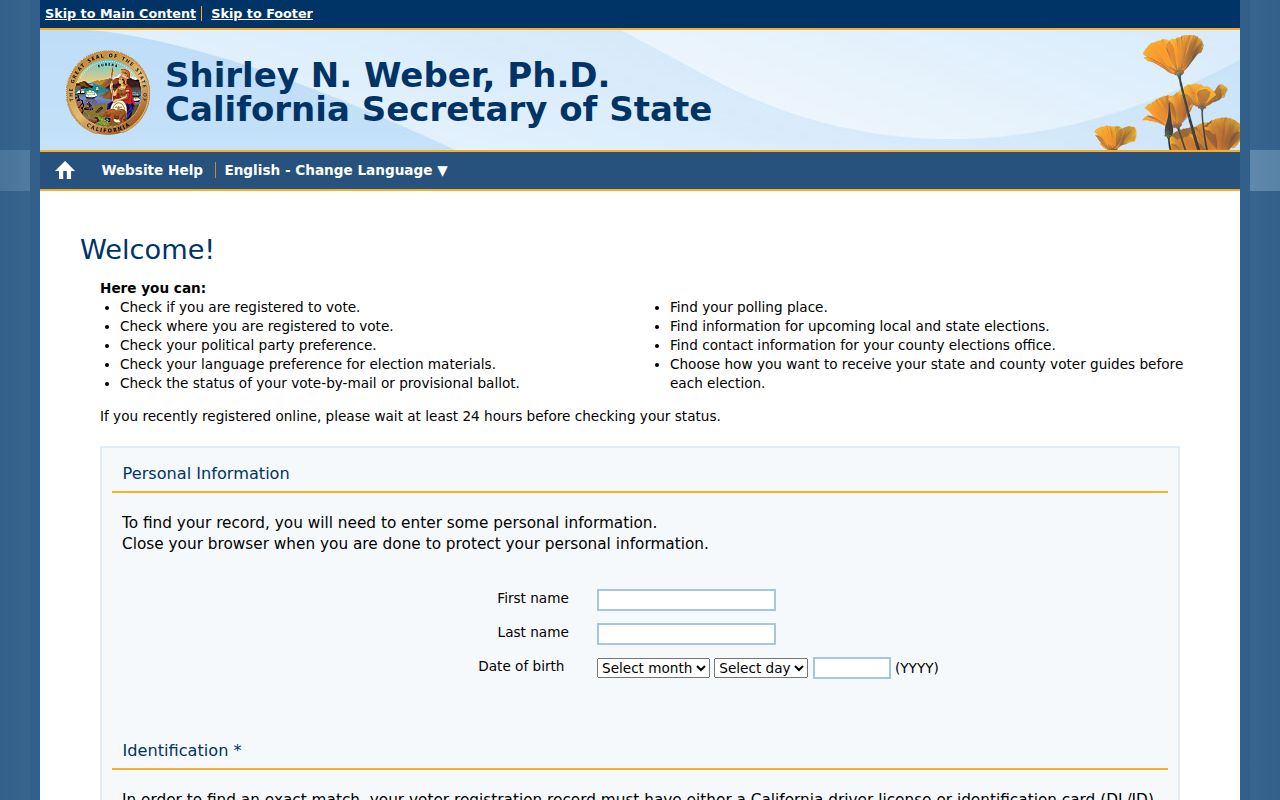
“Registered” or “inactive” is not a conclusion about present occupancy. Safe at Home and confidential voter protections can hide or substitute an address.
Note: An authenticated status result belongs to the voter who completes the check, not to a public Lompoc street list.
California Vital Records for Lompoc Families
Birth, death, and marriage copies for Santa Barbara County events generally route through the County Clerk-Recorder, while the California Department of Public Health provides statewide products. Divorce judgments come from Superior Court. A CDPH Certificate of Record for dissolution is not the decree and does not contain every term of the case.
California uses authorized and informational copies under Health and Safety Code sections 103525 and 103526. The VS 111 birth-copy form asks for the subject's name, sex, date and place of birth, parent names, requester relationship, purpose, copy count, signature, and sworn statement. A mailed authorized-copy statement must be notarized. An informational copy is marked not valid to establish identity. Confidential marriage, adoption, and sealed matters have additional limits.
State 2026 fees in the research are $31 birth, $26 death, $19 marriage, $18 dissolution certificate, $23 fetal death, and $28 stillbirth. A no-record response retains the search fee. The county's official pages describe death and marriage holdings from 1850 through current county events; confirm birth coverage with the current county form page before stating an earliest year.
For an application route, use the California Vital Records page and the current VS 111 birth form. A permitted copy can then be compared with the Lompoc 1915 to 1919 FamilySearch catalog, newspapers, directories, cemetery leads, or probate.
[RESEARCH GAP: No successful vital-record application screenshot was assigned to this page. Use the linked CDPH instructions and current VS 111 form for the live application view.]
Lompoc Heirs Through Probate and Recorded Documents
An heir search is a category workflow, not a free-form people search. Begin with a death record or obituary, then locate the public probate register or petition and any recorded distribution instrument. A filing address can be old, a relationship can be described in a legal context, and a later deed can use a different name. Keep each event's date, role, and custodian visible.
The county recorder's deed chain can show a transfer after an estate event. Superior Court probate records can show a case number and public register events. Newspapers and the Historical Society index can add a family clue. The court records page explains which categories are public and which remain confidential or sealed.
Use an heir lead to locate the correct custodian or to support a family-history project. Do not publish a sensitive address from an old filing or treat a relationship reference as permission to contact someone through an intrusive channel.
Former Classmates in Lompoc Directories
Yearbooks, city directories, Historical Society newsletters, the Lompoc Journal, and local name indexes can reconnect a classmate across decades. Search the school year, surname, initials, and neighborhood clue, then compare a later directory or newspaper item. The Lompoc Public Library catalog is the place to ask for high-school yearbooks, newspaper microfilm, obituary indexes, and licensed genealogy databases.
A school or club mention is a historical lead. It does not prove a current address. If the search turns toward a current person, use a permitted official record and a second identity anchor. Respect private alumni, congregation, organization, and family rosters when a repository does not publish them.
The SBCGS name database can help bridge a surname to an event location or five-year date range. Preserve the result citation and the spelling used by the collection.
Lompoc Business and License Clues
A business name or license can supply a useful affiliation when a resident search begins with an organization, trade, or public-facing credential. The California Secretary of State bizfile Online Business Search accepts an entity name or file number, requires at least three characters for a name, and offers filters for starts-with, entity group or type, status, initial filing date, and public-company disclosure. Results can include entity name, file number, filing date, status, type, formation jurisdiction, agent, principal and mailing addresses, history, and downloadable filings.
The agent or principal address is business or service evidence, never automatic residence proof. County fictitious business name records add registrant and business-address context. The California Department of Consumer Affairs license search and board tools may show licensee name, number, type, status, issue or expiration, business address, and discipline. Board coverage varies, so identify the issuing board.
The state business-search image below is linked to the official portal. Search California business filings before relying on a business name.
The license-search image shows a different state path. Open California license search and treat a business address as an affiliation with the license, not proof of a home.
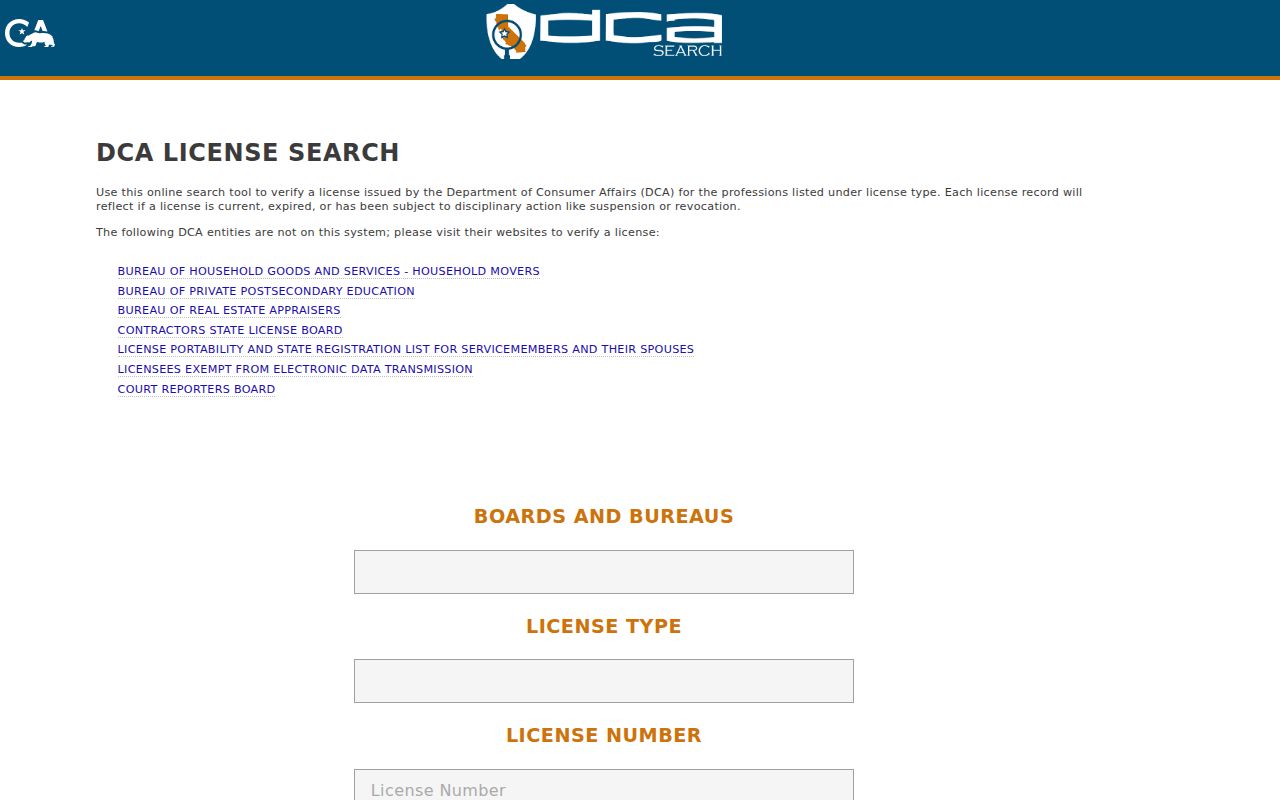
Note: A license or business filing identifies a professional or entity relationship, while residence requires separate evidence.
Lompoc Names in California Unclaimed Property
The California State Controller's unclaimed-property search is a free official name tool. A result can identify an owner name and property type held by the state, but it does not prove a Lompoc residence or current location. Claims go through the Controller. An advance-fee demand from a supposed finder is a warning sign.
Use the exact name, alternate spelling, and prior city clue that the official form permits. Record the property type and claim route, then stop short of publishing a sensitive detail. A claim result is one identity anchor that should be compared with a separate, lawful record.
The official Controller image is linked to the search service. Search California unclaimed property directly and keep the result's status with the date checked.
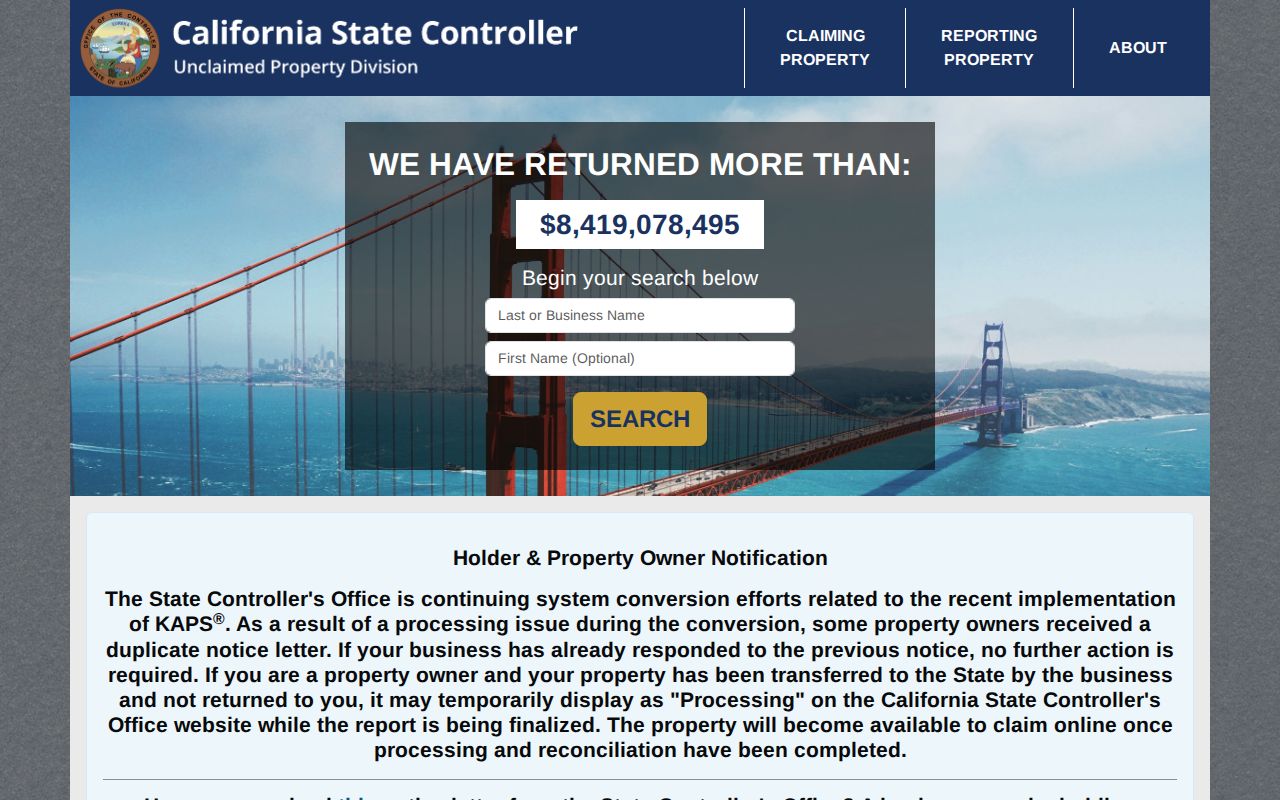
The unclaimed-property page is a state claim channel, not a resident directory. It belongs in a lookup only when the name and purpose fit the official service.
Correcting a Lompoc Index Result
An index and an underlying record are different things. If a recorder result has a misspelled name, preserve the instrument number and legal description, then ask the Clerk-Recorder about the correction path. If a court register appears wrong, contact the court records division with the case number and specific field; staff can explain procedure but will not confirm protected identity details by phone or email.
For a city permit or police record, point to the address, incident or permit number, date, and exact error. The Lompoc Police Records Bureau accepts web, email, and phone requests, but victim, witness, juvenile, medical, confidential criminal-history, and active-investigation material may be withheld or redacted. A correction request does not guarantee that a public record will be rewritten; it routes the question to the keeper.
Keep a correction log with the original search, screenshot or document number, the source page, and the response. That creates a better audit trail than silently replacing an uncertain match.
Where a Lompoc Resident Lookup Stops
A Lompoc resident lookup must stay within lawful personal, family-history, civic, property, or safety research. California stalking law, the civil harassment process, voter-file restrictions, DMV privacy law, and Safe at Home protections all limit how an address or identity clue may be used. Public availability never removes a person's right to protected handling.
The Safe at Home program gives eligible participants a substitute address and confidential handling. It is not retroactive erasure. Confidential marriage, adoption, juvenile, sealed, protected family, and restricted voter material may remain closed even when a name is known.
Use care. Do not use a resident lookup to stalk, harass, intimidate, or harm anyone. When a record is sensitive or a match is uncertain, stop at the custodian's access rules and verify before acting.
For privacy concerns involving commercial republication, California's DROP service and CCPA guidance explain deletion, correction, and opt-out routes. Those tools address data handling; they do not change the official county, court, or state record.