
Lompoc City Directory Holdings, 1886 to 1991
The clearest umbrella holding is the Santa Barbara County printed-directory run at the Sahyun Genealogical Library, reported as 1886 through 1991. That span is county-wide, not a promise of a Lompoc volume for every year. Ask the library which publisher, edition, and reverse section actually includes Lompoc. The SBCGS collection also includes selected digitized items, while the Lompoc Valley Historical Society and public library add local material that may not be indexed in a county directory.
The table separates the main shelves and online paths. Access can mean an open scan, onsite volume, library database, or a finding-aid request. A citation should preserve the exact collection name and year.
| Collection | Years | Where held | Access |
|---|---|---|---|
| Santa Barbara County printed directories | 1886-1991 umbrella run | Sahyun Genealogical Library | Onsite; confirm Lompoc volume |
| Digitized local directories and materials | 1877 Great Register; 1886 and 1895-96 directories; 1922 business directory; 1926 telephone book | SBCGS website | Online selections |
| LVHS newsletters and name index | Scans from 1964; index volumes 1-132, 1974-2017 | Lompoc Valley Historical Society | Online surname, first-name, and place index |
| Lompoc vital register | 1915-1919 | FamilySearch catalog | Digitized or microfilm access subject to site rules |
| Lompoc Journal | 1894-1918 | California Digital Newspaper Collection | Online OCR and page images where cataloged |
| Sanborn maps | 1886, 1891, 1895, 1909, 1921 | Library of Congress | Online sheets |
A Lompoc city directory result becomes more useful when paired with a census, newspaper, deed, obituary, or permitted vital record. The directory supplies continuity between larger, less frequent record sets.
Note: A county-wide run marks repository coverage, not proof that every Lompoc year or reverse section survives on the shelf.
Lompoc Directory Volume Gaps and Coverage
Sahyun Genealogical Library is at 316 Castillo Street in Santa Barbara, with phone 805-884-9909. Its holdings include directories, yearbooks, county and local histories, family histories, census, vital, land, cemetery, immigration, and military sources. Onsite databases include Ancestry Library Edition and American Ancestors. The exact Lompoc publisher and year-by-year run remains a librarian question, which is a useful fact rather than a defect to hide.
The Sahyun collection page is the holding-library reference for this county-wide directory shelf. Review Sahyun Genealogical Library holdings before planning an onsite visit.
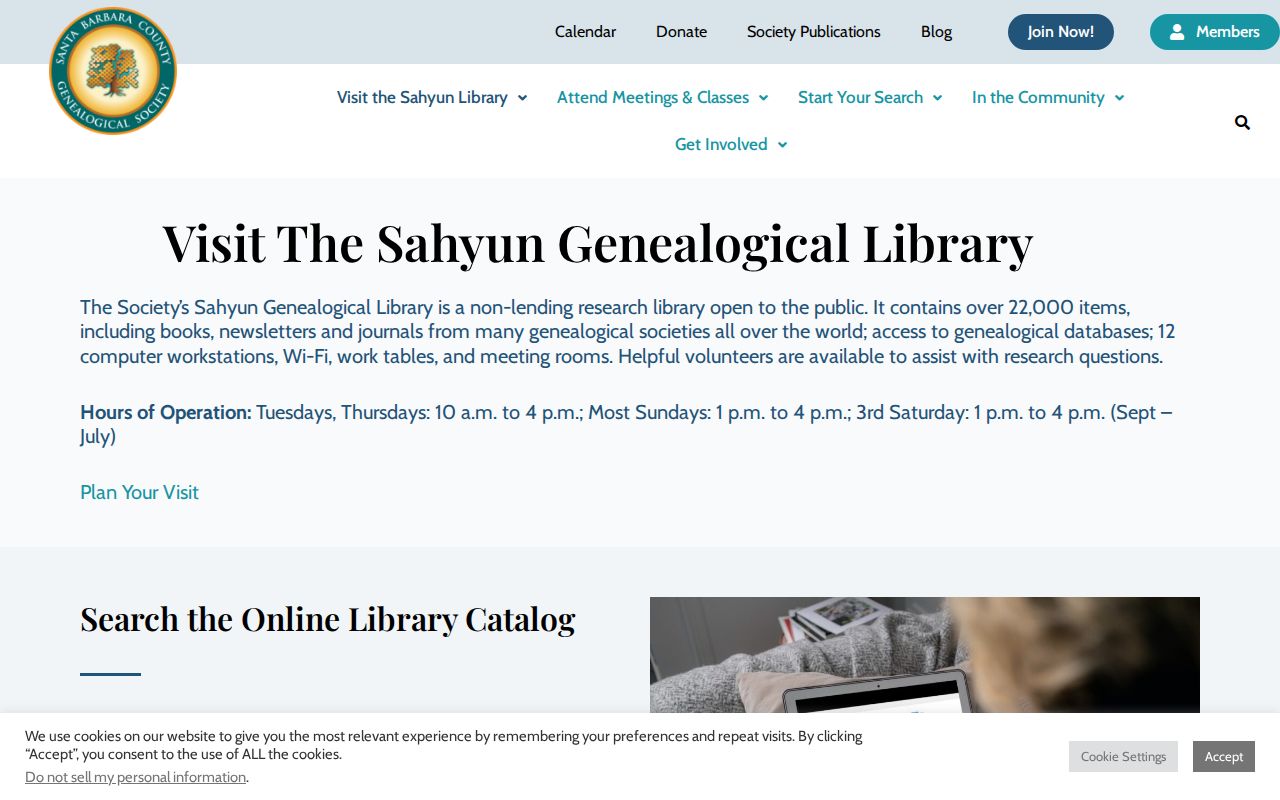
The library image identifies the repository, while the librarian still needs to confirm the exact Lompoc volume, publisher, year, and reverse section.
The SBCGS digitized materials page confirms selected collections, but a stable Lompoc-specific sample entry was not exposed in the research capture. Do not present a model Polk-style line as a transcription. Ask for the volume title page, publisher, year, and abbreviation key before expanding a symbol or assigning a household.
World events, publication gaps, changed coverage, and missing shelf copies can all create a blank year. Move one edition earlier and later. If a name disappears, test a spouse, initial, surname variant, nearby address, or different listing section before concluding that a family left Lompoc.
Inside a Lompoc City Directory Listing
A historical Lompoc city directory entry is a compact clue set. Depending on the volume, it can include surname, given name or initials, a spouse in parentheses, a widow notation, a trade or civic role, a residence address, and symbols that distinguish a householder from another listing. Telephone books usually supply a subscriber and number with less family context.
Read the title page and key first. The research specifically warns against expanding abbreviations such as r, h, bds, or wid without the volume's own explanation. An entry's punctuation, initials, and page arrangement are part of the source.
| Entry clue | What to record |
|---|---|
| Name | Exact spelling, given name, initials, spouse, and widow notation. |
| Trade or role | The line or civic role printed by that volume, without turning it into current identity proof. |
| Residence | House number and street, including a reverse-section cross-check when available. |
| Owner or householder mark | The symbol or abbreviation as printed, with the volume key beside it. |
| Page and edition | Publisher, year, page, scan or shelf call number, and access date. |
- Criss-cross directory
- A reverse section that starts with a street and house number and points to an occupant or subscriber.
- Householder index
- A name or address arrangement centered on the person listed for a household, where the volume defines it that way.
- Abbreviation key
- The volume's own legend for short marks; it should be photographed or cited before interpretation.
- Index versus image
- An index helps find a page, while the scanned or physical page supplies the entry's exact context.
Note: The printed key controls an abbreviation's meaning, so cite it before treating a short mark as a household fact.
Lompoc Reverse Directories by Street
Alphabetical entries answer “who was listed under this surname?” A reverse or householder section answers “who was listed at this street and number?” The second route is valuable for a previous-residents question, but only if that edition actually includes a reverse section. Telephone books may be subscriber lists, not full household records.
Start with the exact street spelling and number from the modern or historic source. Compare the line with the map and nearby entries. Then move to the alphabetical half to see whether the same person appears with a spouse, a different role, or a related address. The reverse section can find a name that an alphabetical search misses, while the alphabetical entry can expose a name variant.
For a current parcel trail, use the Lompoc by-street address workflow. The city directory layer is strongest for historical placement, not for a complete modern list.
Lompoc Names in SBCGS Digitized Collections
The Santa Barbara County Genealogical Society database reports more than 200,000 local names and was last reported updated September 2, 2025. Filters include an event date or a plus-or-minus five-year range, event location, and keywords. Search tips recommend alternate spellings, nicknames, and role terms such as juror, witness, military, or credential. Those terms can surface a local mention without assuming that the hit is a current resident.
The digitized collection image below is linked to the Society's other-materials page. Open SBCGS digitized directories and local materials to see which item is available online and which requires a library or image request.
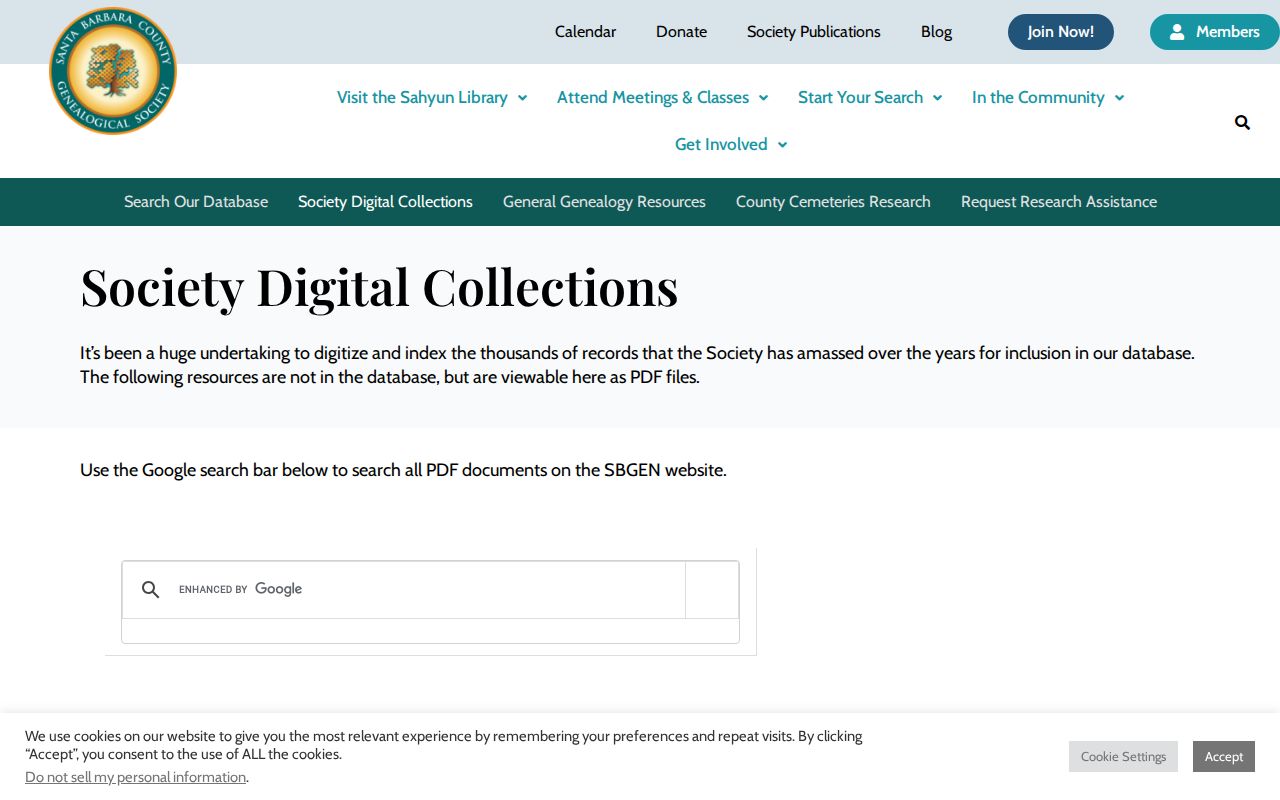
The capture shows a collection doorway, not a guaranteed Lompoc entry. Record the title and page of the item you use, then corroborate a household clue with an independent source.
The SBCGS name-search screen is a second route into the local index. Open the SBCGS local-name database to review its filters and search tips.
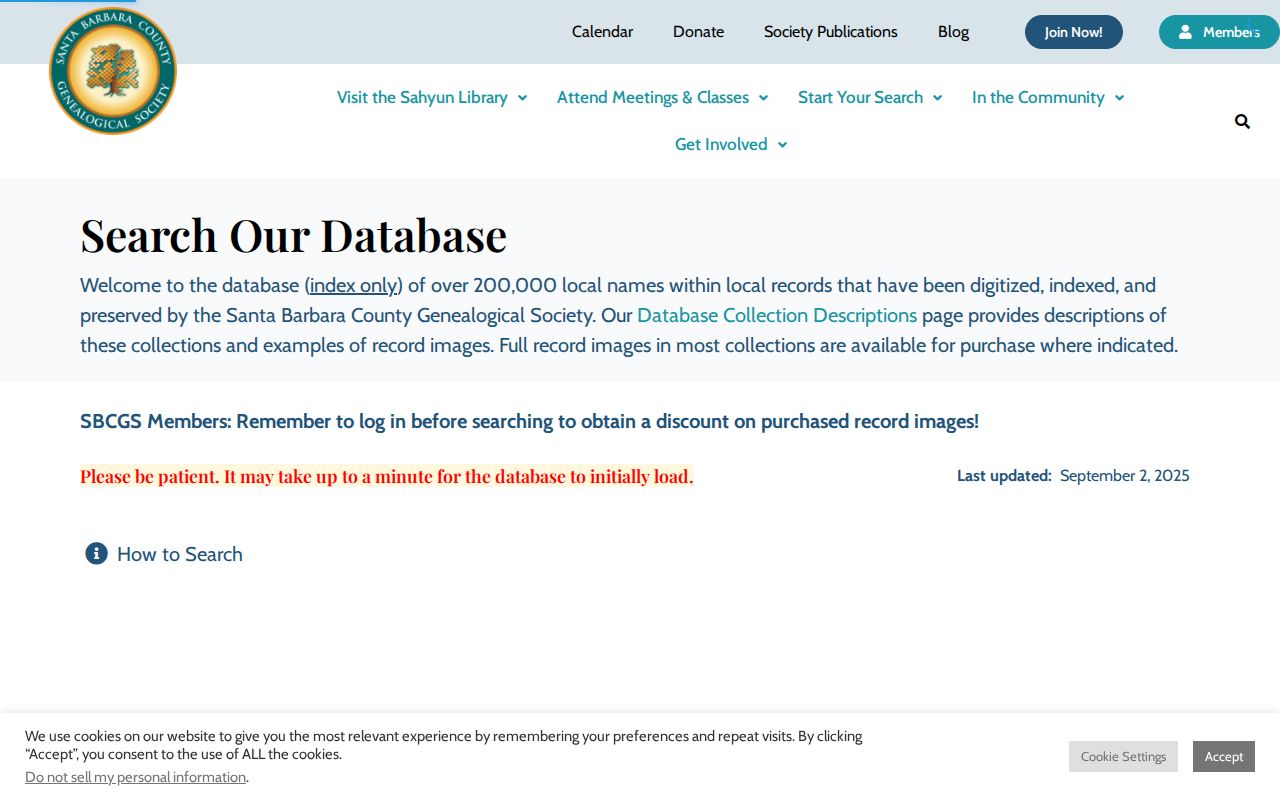
The database image supports the search-method description. It does not change the need to cite the original collection or inspect an available page image.
Many images can be purchased, and members receive a discount. Onsite or licensed database access can also vary. Note the access condition in a research log so a future reader can repeat the search.
Note: A local-name index can surface a lead quickly, but the original scan or collection citation supplies the context.
Lompoc Historical Society Index
The Lompoc Valley Historical Society newsletter index is unusually useful for local names. Search first name, surname, and place across scans from 1964 and index volumes 1 through 132 for 1974 to 2017, then inspect the scan. A newsletter may mention a school, club, property, cemetery, family event, or local project that never enters a deed index.
The historical society image below is linked to its newsletter and holdings page. Search Lompoc Valley Historical Society newsletters for a surname, place, or first name, and keep the issue and page with the result.
The image represents the local-history layer that surrounds the formal city directory. A society index is a lead and a citation aid, not a certified identity record.
Lompoc Journal Names from 1894 to 1918
The California Digital Newspaper Collection, identified by the Historical Society, includes the Lompoc Journal run from 1894 through 1918. OCR can split names, misread type, or miss a column, so search several spellings and browse the page image around a hit. Newspapers can connect a directory address to a family event, civic meeting, school note, property transaction, obituary, or public notice.
Use a newspaper result as a bridge. Record the date, title, page, spelling, and nearby names. Then compare it with the county directory, census, recorded instrument, permitted vital record, or cemetery lead. A notice may describe a person at one moment and does not by itself establish a later address.
Local names can also appear through FamilySearch's Lompoc vital-register catalog for 1915 to 1919. Access depends on the catalog's current login or viewing rules, so cite the film or digital item rather than copying a generalized date.
Lompoc Library Local-History Shelf
The Lompoc Public Library catalog lists the library at 100 Civic Center Plaza with phone 805-736-1261 and weekday hours of 9:00 a.m. to 5:00 p.m. The system serves Lompoc and Vandenberg Village and operates a bookmobile. The online catalog does not publish exact city-directory runs, so ask for the local-history room or shelf by title and year.
Ask specifically about Lompoc city and reverse directories, telephone books, high-school yearbooks, obituary indexes, newspaper microfilm, and licensed genealogy databases. Library staff can also point to a title that is cataloged under Santa Barbara County rather than Lompoc. The first Lompoc library opened in a Carnegie-funded building in 1911; the later museum and Historical Society continuity helps explain why local material is distributed across institutions.
[RESEARCH GAP: No successful Lompoc Public Library local-history screenshot was assigned to this page. Confirm the current catalog and local-history details live.]
When a volume is onsite only, request a page citation or scan under the library's current rules. A precise shelf request is more useful than a broad surname request.
Trace a Household Through Lompoc City Directories
A Lompoc city directory is most powerful between census years. The public federal census is available through 1950 under the 72-year rule, while directories can provide intervening annual or near-annual clues when a volume exists. Use the directory for the address and household shape, and use official records for events that require stronger proof.
- Choose the closest directory year and record the title page, publisher, edition, page, and abbreviation key.
- Search the surname, spouse, initials, and likely address; keep every spelling as printed.
- Move one issue earlier and later to track an arrival, departure, changed address, household split, or changed listing.
- Flip to a reverse section, if present, to compare the street and neighboring entries with the alphabetical result.
- Pair the sequence with a 1900 through 1950 census, newspaper, obituary, probate, deed, or permitted vital record.
Disappearance from one directory can mean a move, death, missing volume, altered listing, or a change in publication. A second year and a second source are the way to tell. For a current identity question, use the Lompoc resident search workflow after the historical clue is anchored.
Note: Directory silence can reflect a missing volume, changed listing, move, or death, so test another year before drawing a conclusion.
1874 Streets Behind Old Lompoc Addresses
Lompoc's street framework was fixed on November 6, 1874. The east-west names included College, Maple, Laurel, Chestnut, Walnut, Ocean, Cypress, Hickory, Olive, Locust, and Willow, while north-south streets followed letters. That pattern helps compare an early directory or Sanborn sheet with a modern map.
The date is a continuity clue, not a verified citywide renumbering event. No general renumbering year was found in the research. Use the street name, map sheet, lot context, APN, and legal description together when an old listing seems not to match a modern address.
| Timeline point | Why it matters for a Lompoc city directory |
|---|---|
| 1874 | Street framework provides an early address bridge. |
| 1886-1921 | Sanborn map runs add building and corridor context. |
| 1894-1918 | Lompoc Journal offers a newspaper name bridge. |
| 1911 | Carnegie-funded library opening begins a local custody story. |
| 1950 and later | Census, directories, newsletters, and digital collections overlap unevenly. |